If you’re past 20 weeks and reading this at 3am because you can’t get comfortable — we see you. After
22 years of pregnancy and postnatal massage across our Birkenhead, Ormiston and Christchurch
clinics, the question our therapists hear most often on the table isn’t about massage at all. It’s “how do I
actually get a decent night’s sleep?”
A good pregnancy pillow is usually a big part of the answer. But “pregnancy pillow” covers everything
from a $25 foam wedge to a $200 modular system, and the wrong choice is an expensive mistake you’re
stuck with for months. This guide explains the four pillow types honestly — including who each one suits
— and exactly what to check before you buy one in New Zealand.
Why Sleep Gets So Hard From the Second Trimester
From around 22 weeks, midwives recommend sleeping on your side. Lying flat on your back lets the
weight of your uterus press on the vena cava — the large vein returning blood to your heart — and with
your blood volume up by as much as 50%, that matters for both you and baby.
The trouble is that unsupported side-sleeping creates its own problems: your top knee drags your pelvis
forward, your bump pulls on your lower back, and your hips carry pressure they’re not used to. That’s the
exact pattern of tension our therapists treat every day — sore lower backs, tight hips, aching glutes. A
well-designed pregnancy pillow holds your body in neutral alignment so those muscles can finally switch
off overnight.
The Four Types of Pregnancy Pillows (and Who Each Suits)
Wedge pillows ($20–$50). A small foam triangle tucked under your bump or behind your back. Cheap,
compact, great for travel. The catch: it supports one spot only, so you’ll still be juggling ordinary pillows
behind your back and between your knees — and re-stacking them every time you roll over.
C-shape pillows ($60–$120). Curl around one side of your body, head to knees. Good support, but it’s
an either/or pillow: it cradles your bump or supports your back, not both at once. Rolling over usually
means dragging the whole pillow with you.
Modular / multi-piece sets ($130–$200). Two or three separate pieces joined by straps. Flexible and
less bulky on the bed, which some mamas love. The trade-off is that the pieces can drift apart during the
night, and you’re paying a premium for the engineering.
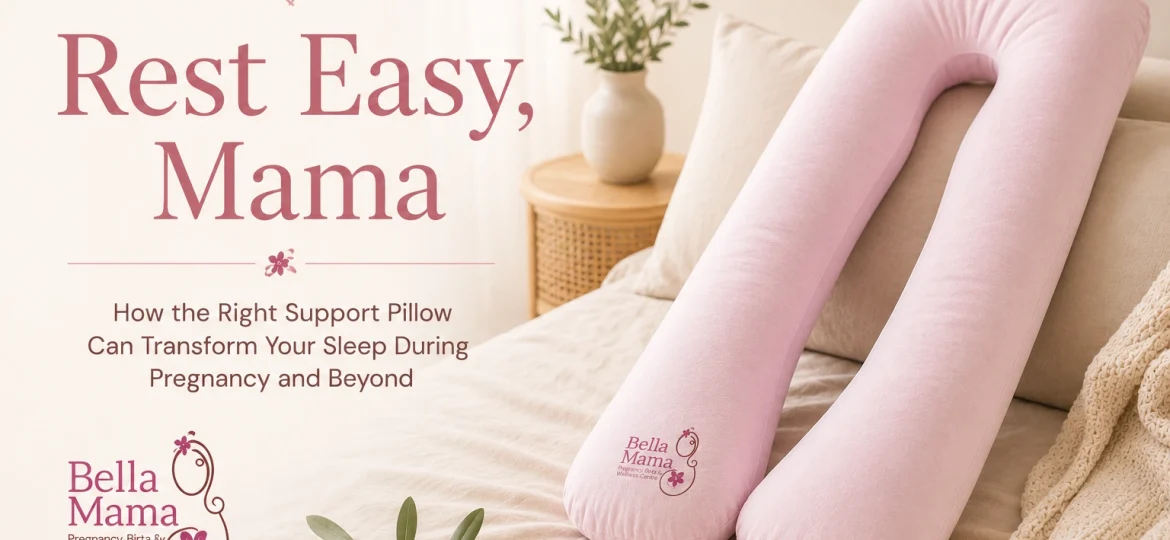
U-shape full-body pillows ($90–$160). Support both sides of your body at the same time — bump
cradled in front, back supported behind, knees separated — and stop you rolling onto your back without
any repositioning. When you switch sides, you just turn within the pillow. The honest downside: they take
up real space, so factor in your bed size and your partner. For most mamas from the second trimester
on, this is the type our therapists recommend, because it solves back, bump and knee support in one
piece.
The 5-Point Checklist Before You Buy Any Pregnancy Pillow in NZ
1. Ask what’s inside — and how much it weighs. This is the single biggest quality difference and
almost nobody checks it. Most cheap pillows sold online are filled with hollow polyester fibre and weigh
under 2kg. They feel fine for the first fortnight, then flatten — right when your bump is getting heavier
and you need support most. Genuine memory foam weighs around 3kg and holds its shape for your
whole pregnancy and beyond. If the listing doesn’t state the weight and filling, that’s your answer.
2. Check the size against your bed. A full-body U-shape is roughly 135 x 70cm. It fits comfortably on a
queen or king. On a double with a partner, measure first.
3. Insist on a removable, machine-washable cover. Pregnancy is warm work and postpartum is
messier. A zip-off cotton cover you can throw in the wash isn’t a nice-to-have, it’s essential hygiene.
4. Think past the birth. The best-value pillows keep working after baby arrives — as a breastfeeding
support, a propped-up recovery rest, and a comfortable nest for night feeds. A pillow you’ll use for 12+
months costs far less per night’s sleep than one you pack away at 40 weeks.
5. Check the NZ practicalities. Confirm the price includes GST, shipping is genuinely NZ-wide (rural
can cost extra anywhere), and interest-free options like Laybuy or Afterpay are available if you’d rather
spread the cost.
Our Therapists’ Pick: The U-Shape Memory Foam Pillow
We’re a pregnancy day spa, not a pillow factory — so the pillow we sell is the one we chose for our own
clients after two decades of treating pregnant bodies. Bella Mama’s U-Shape Memory Foam Maternity Pillow uses genuine 3kg memory foam and targets the five zones we treat most in
the clinic: lower back, hips, knees, legs and neck.
It’s $99 including GST with free metro NZ shipping, the cotton cover zips off for the wash, and it converts
to a nursing pillow once baby arrives. And because we have clinics in Birkenhead, Ormiston and
Christchurch CBD, you can come in and actually feel the difference between memory foam and hollow
fibre before you spend a dollar — something no online-only pillow brand can offer.
When Should You Start Using a Pregnancy Pillow?
Most mamas feel the need between 16 and 20 weeks, when the bump starts to change how you lie. If
you have a history of back pain, pelvic girdle pain or sciatica, start earlier — supporting your alignment
before the discomfort sets in is easier than fixing it afterwards. And from 22 weeks, when side-sleeping
becomes the recommendation, a pillow that physically stops you rolling onto your back does the
remembering for you.
Are pregnancy pillows actually worth it?
If you’re waking with a sore back or hips, yes. Better sleep positioning reduces the muscular tension that
builds through pregnancy — our therapists see the difference in clients’ bodies on the table. Some
clients tell us a good pillow reduced how often they needed pain-relief treatments.
Can’t I just use normal pillows?
You can — many mamas start that way. The problem is that ordinary pillows compress and scatter
overnight, so you wake every time you turn and have to rebuild your nest. One shaped pillow that holds
its form is what you’re really paying for.
U-shape or C-shape — which is better?
U-shape if you want bump and back support at the same time and you have the bed space. C-shape if
your bed is smaller and you mainly need support on one side.
How much should I spend on a pregnancy pillow in NZ?
Expect $90–$160 for a quality full-body pillow with proper filling. Below that price, check the weight and
filling carefully — a $60 pillow that collapses in three weeks is more expensive than a $99 one that lasts
two pregnancies.
Can I keep using it after the baby arrives?
Yes — the U-shape works as a breastfeeding support and recovery rest. Many Bella Mama clients are
still using theirs a year after birth.
Bella Mama has cared for New Zealand mothers for 22 years, with pregnancy day spa clinics in Birkenhead
(Auckland), Ormiston (Auckland) and Christchurch CBD. Every product in our shop is chosen and used by
our own therapists. Questions about sleep, support or your pregnancy comfort? Contact us — we’d love to help.